
The Cognitive Component of Anxiety

The Cognitive Component of Anxiety
The cognitive component of anxiety is very critical to the treatment of anxiety. Whereas the physiological component underlies the three other components of Cognitive, Emotional, Behavioral, amplifying their expression, the cognitive component acts as the actual trigger to the experience of anxiety. A very important point to remember is this: “ALL SITUATIONS AND CIRCUMSTANCES ARE NEUTRAL”. This is to say, no circumstance carries with it, inherently, FEAR. It is our mind’s framing of the situation that creates an experience of fear. Consider the following: Two people are walking down the street together chatting, and come across a situation where a dog is jumping up on a child. The first experiences a rush of warmth and love, thinking of playing with their dog from childhood. The second experiences a rush of panic thinking of their childhood and the dog attack they experienced at the age of 5. These are two completely different emotional experiences from the same situation. One person’s mind automatically thinks about, and frames a loving interaction, while the second automatically has a frame of reference of a threatening situation. Always, it is the thought that frames our experience, which, in turn, precipitates
an emotion. This is key because we can exercise choice in what we think. Because emotions derive from how we think about things or frame them, then we have no direct control over emotions. We cannot choose an emotion directly, but we can directly choose a way to think about something and thereby, indirectly, influence the emotion this way. The fact that we can have direct control of what we think, but cannot exercise direct control over emotions is critical, as we will discuss in the EMOTION COMPONENT section.
It is not always the case that we are aware of thoughts that precipitate emotions because our thinking, or framing of situations, is very automatic or conditioned. We are used to thinking certain ways, out of habit. We develop habits of thinking over time. These are just patterns of thinking given certain stimulus cues (events) in our environment. When these habits become so automatic that we are not even aware of them, then we call them “subconscious”. Subconscious just means out of awareness. It doesn’t mean that we cannot become aware of the thoughts it just means that they are so automatic that we don’t recognize them. This automatic thinking is a double-edged sword. It allows for the economizing of thinking and then acting. Something happens and we automatically think this or that and take action accordingly, very economical.
However, if we have made a mistake in the thinking process (a Cognitive Distortion) it becomes difficult to be aware of the thought that actually CAUSED the emotional experience as the thought has become automatic. Because we miss the link between thought and emotion (the thought that precipitates the emotion has become “subconscious”) the mind associates the environmental stimulus as the “cause” of the emotion. Once we mistake the cause of the emotion (the event instead of the thought about the event), and it happens often, then we are off on a journey where we cannot address the actual cause of the emotion because we are trying to change something that hasn’t caused it, a wild goose chase of sorts. And, this is how dealing with anxiety feels, to many people, something very difficult on which to get a grip. This is why…because we are trying to change something (the environmental stimulus) that hasn’t actually caused the emotion (but is associated with it), and don’t change the thing that has directly caused the emotion, OUR FRAME OF REFERENCE, or THINKING!
This is why the COGNITIVE COMPONENT is so critical. The physiological component sensitizes and creates the “voltage” with which we experience anxiety while the thinking is what starts the ball rolling, or the actual switch. So our starting strategy is to reset the “volume” or “set point” on the underlying physiological component, and now we are going to implement phase two, address the initial cause or spark to anxiety, the cognitive component. Our first task with the cognitive component, then, is to become aware of the thoughts that are associated with the emotion of FEAR OR ANXIETY. Once we have those rascals by the neck then we proceed to change them. Remember they are slick because they have become automatic and may be out of awareness, “subconscious”.

Thought Monitoring
The initial technique of thought monitoring is actually quite simple. Not necessarily easy, but simple. It will take effort but is not complicated. Just be “curious” about what ever thoughts are passing through your mind when ever you experience the emotion of anxiety, and then write it down.
Just the recognizing and bringing to conscious awareness of these automatic thoughts is helpful in changing the experience of fear because it begins to shift the locus of causation from the external object to the actual cause, the thoughts. These thoughts that are associated with anxiety are the things that cause the anxiety, and that the anxiety, then, encourages you to think about.
Once we recognize the thoughts, we will be able to place them into one of the major categories of cognitive distortions that follow. Remember the second technique following THOUGHT MONITORING is to RECOGNIZE cognitive distortions and REPLACE them with accurate perceptions/thoughts. So now we will look at some of the major cognitive distortions associated with anxiety.

Fortune Telling
One of the primary distortions that spark anxiety is FORTUNE TELLING. Keep in mind that the emotional experience of anxiety is always triggered by the mind thinking about something outside the moment. That is, the experience never comes from what is happening now, but either what might happen in a second, or a minute, or a day, or a month from now. Or, it derives from thinking about something in the past. Generally, with anxiety we find that anticipatory anxiety is the primary experience so that will be our focus. The rule of thumb to remember is that anxiety “IS NOT TRIGGERED FROM THE MIND BEING FOCUSED IN THE MOMENT”, but jumping to some thought about the future! Our accurate, replacement thought will be constructed with this idea in mind. Now, let’s get a flavor of what a Fortune Telling distortion is like.
Fortune Telling can take many forms, but often it starts with a “WHAT IF”. For example, “what if I won’t be able to do the assignment” or “what if I embarrass myself in front of all those people?” These types of thoughts, which are thoughts of some
how not being able to MANAGE in the future, will trigger anxiety because it is a perceived threat.
The threatening thought will cause the emotion of fear along with the physiology being aroused (fight or flight response), which will in turn promote more fearful thoughts. One might ruminate (continue to think anxiety producing thoughts) over this idea of being embarrassed for long periods of time until they might decide not to go to the social event (avoidance) the behavioral component.
In order to develop a replacement thought that is “an accurate idea” as opposed to “the distortion” or Fortune Telling we will use the fact that the mind has a habit of jumping-to-the-conclusion that we won’t be able to manage some situation in the future. The specific ”thing” we won’t be able to manage (the social encounter) is less important than the process of jumping to the conclusion that “I won’t be able to manage”.
This process of not being able to manage will be the common thread throughout all the “specific” situations that the mind might come up with in “Fortune Telling” (what if I can’t do the assignment, what if I mess up at work, what if people laugh at me, etc). Somehow, “I won’t be able to manage” is present in all these situations. So, “I won’t be able to manage something in the future” is the distortion or habit we want to change. So, whenever we RECOGNIZE the distortion of “Fortune Telling” we want to REPLACE it with our replacement, which is the simple truth of the situation.
The replacement for Fortune Telling is “I DON’T KNOW WHAT THE FUTURE WILL BRING, BUT I DO KNOW THAT I CAN MANAGE ANYTHING RIGHT NOW!!!” Notice that the replacement is developing a new pattern that is two fold. The first part is bringing the mind back to the present moment, where there is no threat, and the second is reminding oneself of the simple truth that, I am managing now.

Changing Subconscious Habits
This process of RECOGNIZING the specific distortion and REPLACING it with the simple truth is not complicated, but it is an effort. Mental habits, which are generally subconscious, got to be habits either by mental repetition or by having some strong emotion associated with the thought. This is a very interesting aspect of the Cognitive Component, changing subconscious habits. Let’s see how it works, how mental habits get or got established and how we can use this to our advantage. If you think back to your earliest childhood memory, whether pleasant or unpleasant, you will notice, in all likelihood, that there is some strong emotion associated with it. Do this for yourself, think of you earliest memory and see if there isn’t some strong emotion associated with it.
The point is, that it can take only one trial or paring of a strong emotion with an experience or thought of something to register it in the subconscious. This is a powerful phenomenon to take advantage of, if we use it purposefully. If we think the replacements with “enthusiasm” or with “feeling” they will get into the subconscious very quickly. This is a technique you can use as a turbo charge to the replacements, to augment the process.

Keep In Mind We Do Not Have To Get Rid Of Old Habit Patterns, We Just Want To Establish New Ones!
The main way habits get established in the subconscious, or automatically is through simple repetition. Just like we used to learn the multiplication tables through repetition by reading flash cards over and over so we can establish our new patterns or habits of thinking by doing our recognizing and replacing regularly.
It is enough to recognize the distortion of lets say Fortune Telling and doing the replacement only 2-3 times per day to establish that type of thinking as a habit. This could take a total time of about 30 seconds per day, so it’s not the time, but the effort of doing it regularly that will trip you up.
Let’s explore some of the things that you can expect to come up as you begin your practice of changing subconscious habit patterns. Being forewarned is being forearmed.

We talked about a few ways that habits
are established in the subconscious, or how automatic patterns get established. Now let’s see how the subconscious works. When you have a fearful thought like “what if I fail the exam next week” we will feel the emotion of fear. This then will cause physiological arousal, which then promotes fearful thoughts. Now, if we recognize the distortion of Fortune Telling and do our replacement then we will notice that this new thought, “I don’t know what the future will bring, but I do know that I can manage anything now” doesn’t fit. IT IS INCONSISTENT WITH THE EMOTION OR FEELING AT THE TIME. This is exactly what it would be, inconsistent with the old emotion, if we were breaking up the old self-reinforcing pattern. However, it feels like a lie, an untruth. From the perspective of untruth, the truth appears to be an untruth. And, you will be inclined not to believe it or continue
thinking it. You will experience this very clearly when you begin to do the practice. This illustrates how the subconscious tends to maintain things that are already in the subconscious. The subconscious is very self-reinforcing, and good at maintaining status quo. This is not a “bad thing” or “evil phenomena” because it helps the mind maintain consistency. It does, however, make it difficult for cognitive change. The key here is that we can exercise direct control over what we think even if it’s not consistent with what we “feel”. Our choice then becomes a very powerful tool, a saving grace, if you will. We can realize here that “FEELINGS ARE NOT FACTS”, and choose to think the new way until it becomes habit and then it will seem valid. Just understanding this process will help you have power over it.
In addition, here is a technique that will help you work with the above subconscious process. The idea is that the entryway into the subconscious is like an aperture. The wider the aperture, or the more open it is, the easier it is to get things into the subconscious. If incoming information is consistent with what already is in the subconscious then the aperture is wide open and the information reinforces what already there. Another way to open the subconscious is to be relaxed, tension tends to close one off to new information. But, for our purposes, liking things makes one open to receiving. So, even though it may seem like an untruth that, I can manage anything now, if you say “I like the idea of being able to manage anything now”, this will open the aperture, and then slip in the rest, and I can manage anything now! This will be a very helpful aid in getting things into the subconscious. Other things that open the aperture are things like hypnosis that allows for the easy introduction of new ideas into the subconscious. Self-hypnosis techniques can be helpful if done professionally, but we won’t go into this area now.
Here is another characteristic of the subconscious mind or that part of the mind that functions out of habit or conditioning. First, by contrast the conscious part of the mind, the part that is engaged in reading and thinking about what is written, is intelligent, purposeful (has choice), loves ideas, is abstract, creative, and is aware. The subconscious mind, as we have indicated before, because it is just the result of patterning, conditioning, and habits of thoughts, is very concrete, basic, not a thinking mind, not intelligent or creative. Because the subconscious is so simple and concrete, and out of the awareness of the conscious mind, the conscious mind has a difficult time dealing with it. First of all the subconscious doesn’t exists for the conscious mind, and second of all it doesn’t like dealing with it because it is so simple and concrete. Your conscious mind would be wise to get over this “pride” because the subconscious weighs in, with respect to creating experience, with about 85% of the vote. In other words, even though the subconscious is simple and the result of conditioning, it carries a lot of influence in terms of creating experience.
This is why you can have the best intentions not to repeat some behavior in the future, but then the circumstances come up again, and presto, you do the same old thing! If you become aware of the workings of the subconscious and act purposefully with respect to it, then you carry tremendous power in terms of shaping your experiences. Although you may automatically think a particular way and this automatic thinking carries with it 85% of the weight of making an experience, if you purposefully think in a new way, it is like adding 10X the force to your conscious thinking power. It pays to think purposefully, to recognize old distorted patterns and replace them with new accurate ones. But know that your mind will be more “comfortable” with old established patterns of thought even though it causes you problems! Moving out side the mind’s comfort zone can be challenging, for the reasons we have stated before. So know that the conscious mind will tend to recoil at doing such simplistic things (as we are suggesting) to change patterns. Remember you can choose to do them anyway, even though you don’t “feel” like it or because your conscious mind tends to “ridicule” you for it.
One final fact, and hint for working with the subconscious, patterned, habitual part of the mind: The best time to change a habitual (subconscious) thought pattern is when it is currently playing in the mind. This means that when you notice the emotion of fear (remember, “the signal” for changing the thought) is the most expeditious time to change the precipitating distorted thought. This is the time when you will “feel” least like it, but the time, if you do exercise choice, that it will be most effective. It is like a jukebox. If you push J6 a particular record plays (conditioned thought, song, in response to a particular environmental stimulus, J6). The best time to put a new record in the machine at location J6 is when the record is playing. So, even though it is the best time to replace a thought, when the emotion is playing, it is also the most difficult time, because you won’t “FEEL” like it! Again, forewarned is forearmed. Keep in mind “FEELINGS ARE NOT FACTS”

Catastrophizing
Another distortion that promotes anxiety is catastrophizing. The automatic thought of creating the worse case scenario is catastrophizing. For example, “what if I get on the plane and it crashes and I die”, this is a catastrophic thought that is a threat and promotes the emotion of fear.
The error in this thinking isn’t of the possibility that one could crash and die, this is true, but this doesn’t cause anxiety. It is the mind mistaking a probability for a possibility. Thinking that I will die is a threat and causes the emotion of fear and physiological arousal (fight or flight), and this then promotes more fearful thinking.
With all anxious thoughts the threatening idea is always possible, so it’s not a productive approach to deny it and say that it isn’t true (i.e., the plane will not crash). There are plenty of counterexamples to that notion. The more helpful approach is to remind yourself of the simple truth. For catastrophizing the replacement is “It is possible that could happen, but it is highly unlikely!”

Out of Control
Thinking that one is out of control is a corner stone of anxiety. Remember that it is thinking or the frame of reference of the mind that precipitates an emotion of feeling out of control (or of about to lose it). Also, keep in mind that “FEELINGS ARE NOT FACTS”. Thoughts of losing one’s mind, dying, losing control of a situation, driving a car over the rail of a bridge, being trapped in an elevator are all examples of being, “Out of Control”. Let’s see how this very interesting distortion works. The idea of being out of control speaks to the fundamentals of how the mind creates experience.
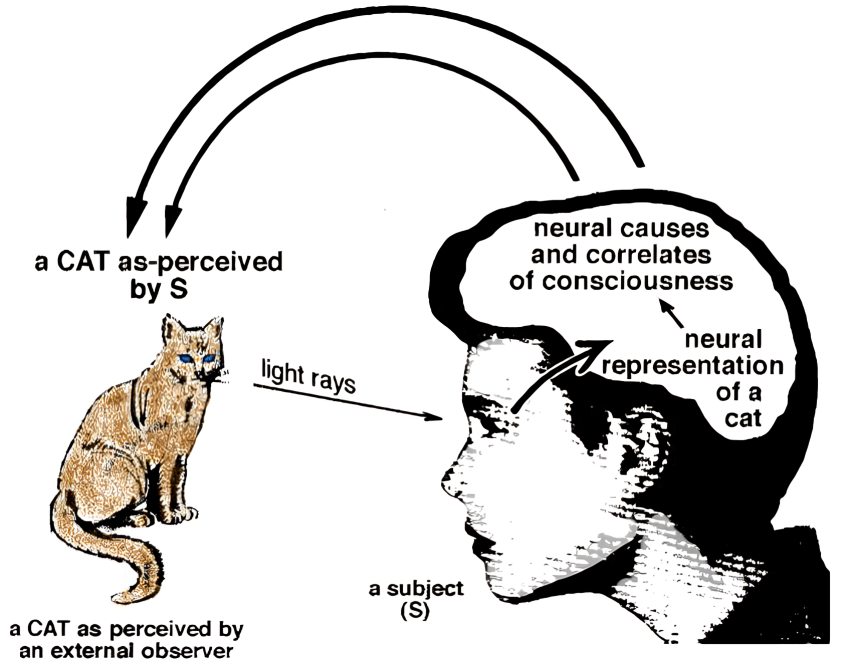
Any and all sensory experience
is a product of sensory information received through the senses, being transmitted through relay neurons into ganglionic nerve centers in the brain and projected to grey matter association areas where we have a perception/experience. This is all to say that sensation and perception are all physiologically based, and constructed phenomenon. This means that we process information and create experiences. I am not talking about creating experiences on purpose or out of choice, this is possible to, but even passive perception is our neurochemical creation. If we create our experiences then who is in control of the experiences? We are of course.This does not mean we are
“consciously” in control, but at least automatically in control. So, although we may not be intending to have a particular experience or even want an experience, it is our nervous system that is creating the experience. Being in control is not to say that we are controlling circumstances or situations that we experience.
It’s just that given a set of circumstances our minds will create an experience of it. As stated prior, we can have conscious choice or conscious participation is the process of experiencing. As we purposefully think a particular way then we will modify our experience accordingly. But, for now, we are just concerned with the fact that our minds are in the business of creating experiences, and as we have said before, this happens pretty much automatically. Although this is most commonly a habitual process and most experiences are created out of conditioning, we still are the author of our experience. Because it is the thought of being out of control that gives us that experience, (not the actual outside stimulus) then we are going to remind ourselves of the simple truth that we are the creators of our experience.
This may sound very simple, and it is, but it is also very profound. Because it is the thought of being out of control that makes us experience that, then by changing that specific thought we will change our experience of being “out of control”. There are many circumstances with which we hold a frame of reference of being “Out of Control”. When we think that we are trapped in an airplane when the door closes is an example, or when we think we will lose control of our minds during a panic attack is another. In the example of the airplane we do not stop creating our experiences once the door closes, so we are still “in control”, or we are busy creating an experience of being out of control. Now, it’s not necessary to tease this riddle-like expression apart in order to benefit from the application of it, but if it helps us to understand how we are “in control” of creating an experience of “out of control” to apply the replacement, then all the better.
What matters in the end, whether understanding or not is the application of the replacement. Once you are in the habit of thinking you are in control while on the airplane it will be obvious to you that you are not out of control even though you are not controlling the airplane or are not able to physically get out of the airplane at this moment, etc. This is reinforced by the understanding that most people cannot get off the earth at this moment but they don’t experience being out of control every second. And, of course if asked why they don’t feel anxious just being on the earth, they would say that, “I, obviously, don’t think of myself as being trapped on the earth”, our point exactly. Parenthetically, some people do experience themselves as being trapped on the planet, and they do have a sense of being out of control.
So, when one RECOGNIZES the distortion of being “Out of Control”, or the thoughts that imply being “out of control”, then use the REPLACEMENT (simple truth) of “I AM IN COMPLETE CONTROL OF MY LIFE. I AM THE CREATOR, DIRECTOR, AND STAR OF MY LIFE. I AM IN CONTROL!” Use this replacement at least two to three times per day to help create the new mental pattern of being in control in situations or circumstances where you used to experience being “out of control”.
Mind Reading
Mind Reading is a distortion particularly associated with anxiety in social situations. Mind Reading is when an individual thinks that they know, or are wondering what another person is thinking about them. In a given situation, usually an ambiguous one, a person jumps to the conclusion that something derogatory is being thought of them. Let’s say that we are at dinner with a group of people where we have a special interest in Susie.
The evening is going well, but somewhere along the line we drop some ketchup on our tie. Susie, sitting next to us sees the spot and quietly brings this to our attention. Immediately we think, “Susie must think I’m a loser!” Now, this is a situation where our mind jumps to the conclusion, out of habit, that Susie is thinking that we are a looser. She could have been thinking anything or nothing at all with respect to us. We really don’t know what she is thinking.
Why, then would our mind jump to the conclusion that Susie is thinking a derogatory thing about us? The reason is two fold. First, we are having a tendency to project the thought onto Susie that she is thinking this or that (namely, we’re a looser), because in reality we don’t know what she is thinking. Secondly, as we

don’t know what she is actually thinking, it’s our mind that holds the derogatory, or “worth less” thought about ourselves given a certain set of circumstances.
Mind Reading then is fueled by our tendency to think of ourselves as “worth less” under certain circumstances, or when we think someone is thinking negatively about us. In other words Mind Reading reflects our propensity to think of ourselves as worthwhile only under certain conditions and our propensity to think we know what others are thinking. The general thought process we are addressing with Mind Reading is “conditional worthiness”. When we RECOGNIZE the distortion of Mind Reading then we want to replace it with, “I DON’T KNOW WHAT THEY ARE THINKING, BUT I DO KNOW THAT I AM GREAT, WONDERFUL, TERRIFIC, WORTHWHILE, VALUABLE NO MATTER WHAT THEY THINK, SAY, 0R DO. AND NO MATTER WHAT I THINK, SAY, OR DO.”